Here are resources for Key Stage 2 learners – ages 7 to 11, Key Stage 3 – ages 11 to 14: Landscape, Habitat, Area, Community, History of Wales.
The resources can be used under a broader theme related to Habitat, Area, History of Wales. These resources are specifically about the World Heritage Site, the Slate Landscape of North West Wales. There are 6 components or areas, within the World Heritage Site, which have an array of unique landscapes and habitats. The history is shared by creatures that live in those areas, such as Guto Bwch Gafr and Menna Min Gafr; the Welsh mountain goats from the Ogwen Valley and Peris, and Tegwen the nocturnal Nightjar, the rare bird, living in the area of Brynreglwys quarry in Abergynolwyn.
- Guto the Billy Goat; What is Slate? Geology, a summary of the formation of the rock, and how it was created.
- Nightjar; Where is the slate in Wales? Geology; Explanation of the locations of the rock, and the reason the quarrying areas developed.
- What is a World Heritage Site?
- The Language of the Slate Quarries
- The Big Strike
- Timeline of the development of Dyffryn Madog and the town of Porthmadog
- History of Porthmadog
- Slate Stories
- Ballast Island, Porthadog
- The history of Porthmadog harbour
- History of Porthmadog and Borth y Gest Ships
- The colours of slate
Guto the Billy Goat; What is Slate?
What is a World Heritage Site?
The Language of the Slate Quarries
Terms, sayings and metaphors.
Description of the resource and further ideas for lessons
Primary school resource KS2 - The language of the slate quarries, with examples of terms, phrases and metaphors borrowed from the slate quarrying industry of Northwest Wales. This resource can be used as an inspirational starting point to research and illustrate other metaphors, sayings and words linked to the industry. The stop motion animation was created by Manod primary school, Blaenau Ffestiniog. Traditional melody 'The quarryman' sung by Ysgol y Garreg, Llanfrothen.
The Big Strike
J R Hughes, an illustrator who documented the strike at Penrhyn quarry, Penrhyn.
This film shows the work of the artist/cartoonist, J.R.Hughes, who sketched a series of illustrations to show the events that happened during the Penrhyn quarry strike in Bethesda, North Wales, 1900-1903. The work was shared in the newspaper, 'Papur Pawb'. The artist was born in Tynygornel, Ynys Môn and was educated in Bangor and Slade School of Art in London, where he became friends with Augustus John. He created illustrations for newspapers, postcard designs and novels. The music is a song composed during the period, 'Punt y Gynffon', (a pound a tail), sang to the melody of the 'Mochyn Du'. The song refers to the slate quarrymen who returned to work during the strike.
Timeline of the development of Dyffryn Madog and the town of Porthmadog


Map of Dyffryn Madog, the estuary of the Glaslyn River, and the Traeth Mawr, showing the names of the islands, the history of dam building in the area, Boston Lodge, and the development of the town.
There is a series of sculptures by Howard Bowcott in the town highlighting its history; more can be found here: Porthmadog Public Art.
Read more on the People's Collection Wales web site: Porthmadog history [timeline 1600-2021].
History of Porthmadog
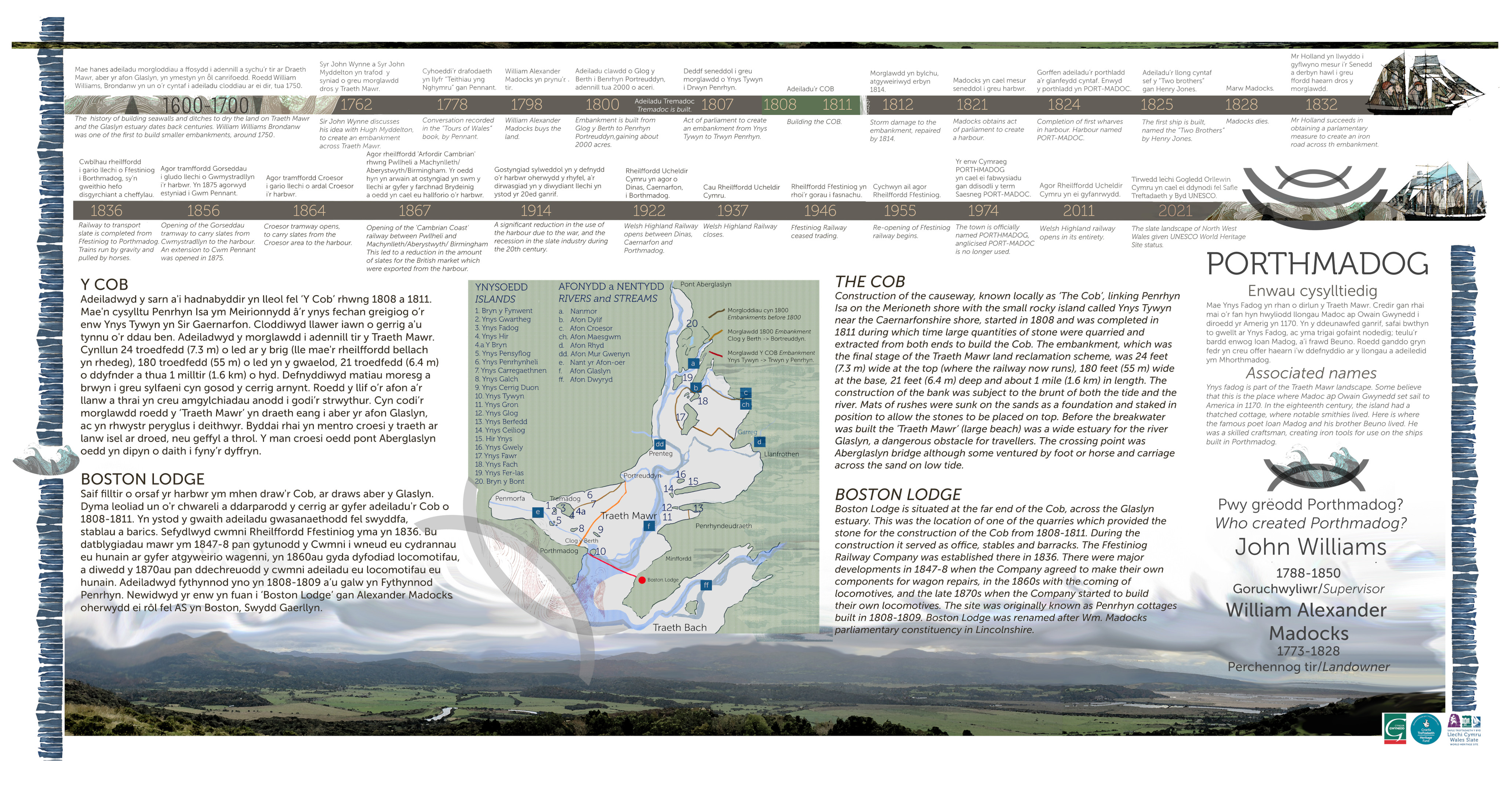

History of Porthmadog [timeline 1600-2021]. LleCHI LleNI educational resource.
Read more on the People's Collection Wales web site: Porthmadog History.
Slate Stories
A collection of short audio clips of stories told firsthand by people who have lived with and worked in the slate quarries.
Ballast Island, Porthadog
There is a very unusual island by Porthmadog harbour, which exists because of the Slate industry. Slate ships travelled to every corner of the world, usually returning empty. The bottom of the ship had to be filled with 'ballast' to stabilise it at sea, so stones, sand, grain, or rubble were carried back to Porthmadog harbour. The stones were dumped on a patch of nearby sand, and over time grew to form 'Ballast Island'. The island was also called 'Lewis Island', after the three brothers who built the quay there. Learn more about the island's interesting history in this short film. It can serve as an inspiration for a creative activity, to create an imaginary island.
The history of Porthmadog harbour
An educational resource for CS2, explaining the history of Porthmadog harbour. This resource can be used with the other resources available on Llechi Cymru website under resources: Voyages from Porthmadog, as well as two films: the history of Ballast Island and Seafearers of Porthmadog, all on Llechi Cymru You Tube channel.
History of Porthmadog and Borth y Gest Ships
Shipbuilding was vital to the prosperity of the slate industry in North Wales. This is a resource that tells the stories of some of the ships that were built in the harbours of Borth y Gest and Porthmadog.
The colours of slate
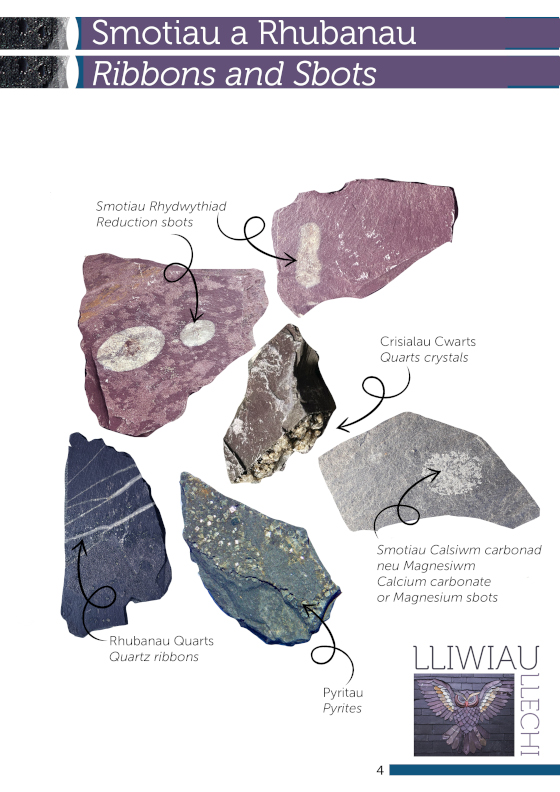
Slates come in different colours mainly because of the minerals inside them and the conditions under which they formed, millions of years ago. The slates from Dyffryn Ogwen usually appear as dark blue-grey or purple. Dyffryn Nantlle is famous for its red, purple, blue and green slate. Dinorwig and Dyffryn Peris slates appear blue-grey or green, Blaenau Ffestiniog grey or blue-grey slate and Abergynolwyn and Tywyn are grey, blue-grey, or silver grey. This resource explains the different colours and provides an opportunity to guess the mineral content in specific examples from different areas within the slate landscape of Northwest Wales
Resource Pack - The colours of slate (.zip)
Example